Showing posts with label Ghost in the Shell. Show all posts

Wednesday, 13 January 2010

Ghost in the Shell Tattoos

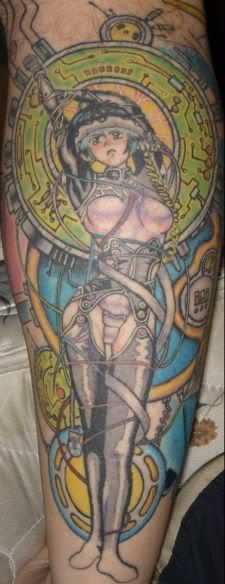
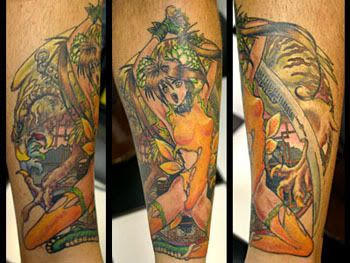
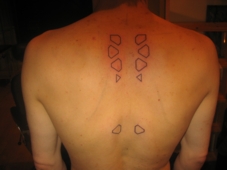
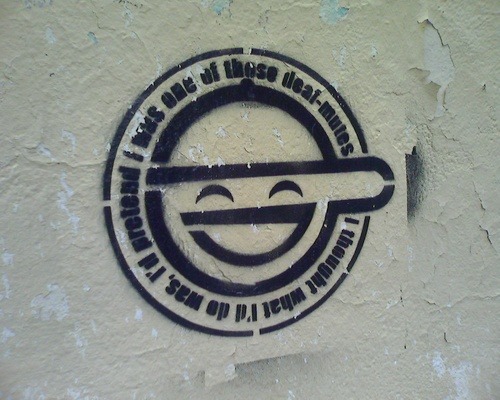
Following my obsession with Masamune Shirow's Ghost in the Shell, here are some GITS-inspired tattoos. I also found one of the laughing man icon, but couldn't link it. Surprisingly, I couldn't find any individual eleven tattoos, but here's someone who's planning to get one.


From M1K3Y

Saturday, 9 January 2010

Synaptic Gasp

A while ago, I posted my own stencil inspired by Ghost in the shell. Here's Synaptic Gasp by ocean.flynn which has similar themes:


ocean.flynn says:
The synaptic cleft in the human brain reminds me of the gap between the hand of God and Adam in Michaelangelo’s visualization of Creation. My mind is stuck on the image of the gap. That’s the leap of faith between that which we can know and that which is beyond our capacity to know.

Sunday, 13 December 2009

Ghost in the Shell Graffiti

I seem to have an obsession with Ghost in the Shell! Here's some stencils I made (see my first one here):

Here's a Tachikoma, an old stencil that I re-sprayed today!


Major Motoko Kusanagi. I messed up the face, so decided to do some kind of light-explosion thing. This is my first attempt at painting with acrylic. Mixing colours was fun, but I realise I didn't really understand layering, and I was still painting in a digital frame of mind.


A Laughing Man icon! The quote is from J.D. Salinger's Catcher in the Rye.


Here are some other stenicls I found on the internet. There were suprisingly few, though.

An amazing stencil from Cyberdelics.


A cheeky stencil plan by Okto.

A much better Laughing Man icon from mmoroca.

This one kind of counts. From Pierre Huyghe, Philippe Parreno.

Thursday, 12 November 2009

Ghost in the Shell


This was my favourite stencil. Unfortunately, the original got lost in a move and I haven't had the heart to do another. It's inspired by Shirow Masamune's original Ghost in the Shell comic. In this scene, the hero glimpses the birth of a new, intelligent life form. The thing in the middle is some kind of neural network, and descending onto it is an angel (the shape pointing down is the shade on a foot, some people don't notice it at first, but after it's pointed out, you can't help seeing it).

The idea is similar to the Sistine Chapel ceiling fresco, where God and Adam reach out towards each other. Michaelangelo captures the question of man's relationship with God. Masamune questions the relationship between man's body and man's spirit.

The medium here also hints at a direction for answers: Stencils are made up of use small, abstract, isolated shapes. However, in a particular configuration, they create an impression of a unified image to human perceivers. However, not all shapes are allowable - you can't have a stencil with free standing opaque parts (e.g. the outline of a full circle). In fact, even convex shapes decrease the integrity of the stencil. So, even as the whole influences how one interprets the parts, the parts influence what that whole can be.

Friday, 6 November 2009

Lazy Linking Friday

Time for some lazy linking!

I've been listening to Archers of Loaf recently - especially the incredible ending to their penultimate album, White Trash Heroes. This is likely to be in my collection forever.

I have been utterly captivated by guitarist hironou2525: Videos of beautiful guitar playing together with links to mp3s and very high quality tabs. Obviously someone who knows a thing or two about cultural transmission. They have a blog here, although I couldn't read it. I especially liked I do:


The Speculative Grammarian is a collection of linguistic satire. There is a load of stuff there, but this set of puns caught my eye.


This recent paper by Novembre et al. is interesting - Genetic distance between people is correlated with the geographic distance between them. In fact, a PCA graph draws a pretty good map of Europe. I was especially interested to see the analysis of Swiss genes - they divide on primary language!

While Linguistic Exogamy (marrying someone outside your linguistic group) is common in liguistically diverse areas of the world (Papua New Guinea, Amazon basin) this analysis may suggest it wasn't practised so much in Europe.


Friday, 23 October 2009

Immersive Worlds

A Replicated Typo recently posted on how bad the new Sci-Fi series Defying Gravity is. Charles Stross's blog on approaches to Sci-Fi is cited, basically making the point that a lot of Sci-Fis add lazers to ordinary dramas without thinking about the consequences for the characters.

It's a good point that many sci-fi programs seem to have fancy technology just for looking at, without any of it changing the way the characters interact or think about the world. However, there are some TV Sci-Fi shows that build the world from the ground up. My favourite example is the Ghost in the Shell spin-off TV series Stand Alone Complex. The show follows a team of anti-terrorists in the year 2030, where society has changed in response to the invention of e-brains and cybernetics. I often got the feeling that Masamune Shirow did not create a world, just write about one he happened to visit at some point.

There are two things that make SAC feel like a total immersion in a different world. Firstly, because it's animated, there is no difference between 'real' and 'CGI'. That is, suspension of disbelief is easier. Secondly, the new technology has a direct affect on the lives of the characters. Not only does the proliferation of cybernetics have an effect on what it means to be human, there are new ways to interact, and new ways to break the law (mind-hacking). Similarly, Orwell's invention of 'Thought-Crime' in Nineteen-Eighty-Four created a culture with new pressures.

As a side-note, also similar to Nineteen-Eighty-Four, SAC looks at the balance between public privacy and public security. However, the heroes of SAC are constantly hindered by lack of surveillance, and the viewer comes to empathise with their need for more information, quite contrary to the reader's response to Winston Smith's situation.

Back to Defying Gravity, it's difficult to see how a small crew going on a single journey aroud the solar system would change a culture. Perhaps Defying Gravity will eventually get around to this. I don't doubt that space travel can change a society's perception of itself, but how different is it from the moon landings for the average person?

Here we get to the root of the distinction between immersive worlds and drama-driven worlds. In the drama-driven world, the big change usually only occurs for a small, elite group of people. For example, Defying Gravity. In an immersive world, the big difference is global and the protagonists are more ordinary people who must survive in it. For example, Nineteen-Eighty-Four or Ghost in the Shell.

Furthermore, the aims of both approaches now becomes apparent. Ordinary society + extraordinary people = drama. Ordinary people + extraordinary society = social commentary/satire. The examples continue: Heroes vs. Dawn of the Dead, Star-Trek vs. Neal Stephenson's Anathem, Dr. Who vs. Watchmen.

So, maybe it's just a lack of satire that A Recplicated Typo is missing. If so, you've got the formula now, so go out and make your own show.